
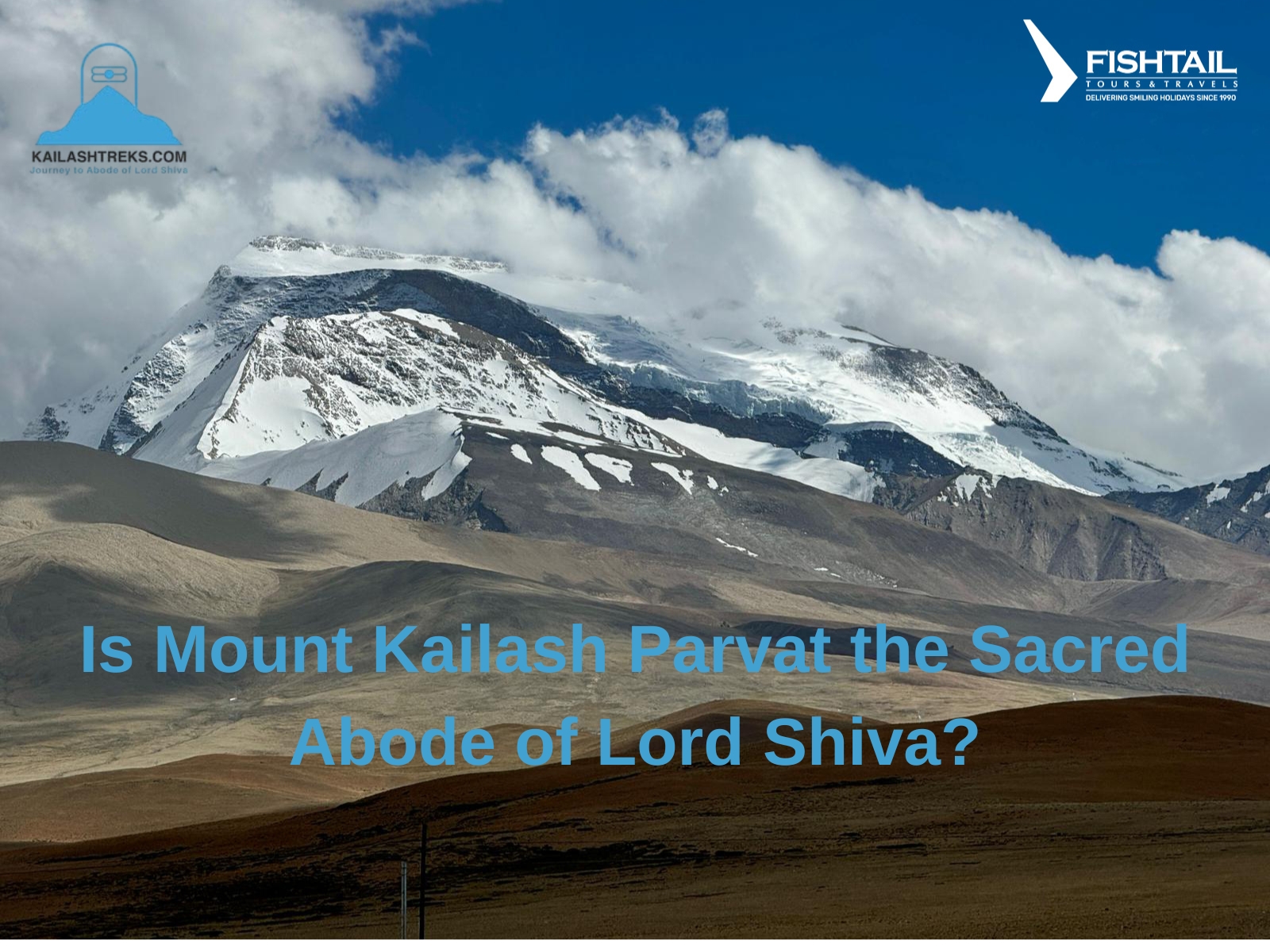
Nestled in the remote western region of Tibet stands a majestic peak shrouded in mystery, reverence, and spiritual wonder — Mount Kailash. Unlike Everest or other Himalayan giants, Mount Kailash is not just a mountain; it’s a spiritual axis, deeply revered in Hinduism, Buddhism, Jainism, and Bon. But in the heart of Hindu belief, it holds a special place as the sacred abode of Lord Shiva, the destroyer and transformer in the holy Trinity.
🕉️ Mount Kailash in Hinduism
According to Hindu scriptures, Lord Shiva resides atop Mount Kailash with Goddess Parvati, his consort. It is said to be the place where he sits in eternal meditation, blessing the world with cosmic energy. The mountain, referred to as Kailasa Parvat, is considered the center of the universe in ancient texts like the Vedas and the Puranas.
The Skanda Purana describes Kailash as the spiritual axis mundi, where the earthly and divine meet. For devotees, this mountain isn’t just rock and ice; it is Shiva himself, an embodiment of divinity.
🌍 A Sacred Site Across Religions
What makes Mount Kailash even more extraordinary is that it’s not only sacred in Hinduism:
-
Buddhists believe it is the home of Demchok (Chakrasamvara), a wrathful manifestation of Buddha.
-
Jains call it Ashtapada, where the first Tirthankara, Rishabhdev, attained liberation.
-
The Bon religion considers it the seat of the sky god Sipaimen.
This convergence of faiths gives Kailash a mystical aura unmatched by any other mountain.
🚫 The Unclimbed Summit
Despite being only 6,638 meters tall — modest compared to Himalayan giants — no human has ever summited Mount Kailash, nor have authorities allowed it. Tibetan belief holds that climbing the mountain would violate its sanctity. Even famed mountaineer Reinhold Messner refused to scale it, stating that the mountain's holiness must be preserved.
Many believe that anyone attempting to reach the summit would face divine consequences — a notion reinforced by strange tales of failed expeditions and sudden deaths.
🚶♂️ The Holy Kailash Parikrama
Thousands of pilgrims from India and around the world undertake the Kailash Mansarovar Yatra, a physically demanding and spiritually uplifting journey. The highlight of this pilgrimage is the 52-kilometer circumambulation (Parikrama) around the base of the mountain — an act believed to erase sins and bring spiritual merit.
Walking around the sacred mountain, through high-altitude passes and rough terrain, is not just a test of endurance, but an act of devotion and transformation.
✨ Myth or Divine Reality?
Is Mount Kailash truly Lord Shiva’s abode? For the faithful, there is no doubt. Science may view it as just another mountain, but to millions of devotees, it radiates a presence — a silence so profound, it speaks. Perhaps some places don’t need to be proven, only experienced.
In the stillness of the Himalayas, where time seems to pause and the world feels distant, Mount Kailash continues to stand, silent, sacred, and eternal.
Conclusion:
Whether seen as a geographic marvel or a spiritual epicenter, Mount Kailash remains one of the most sacred places on Earth. And for those who believe, it is indeed the celestial throne of Lord Shiva, the timeless yogi and eternal guardian of cosmic balance.