
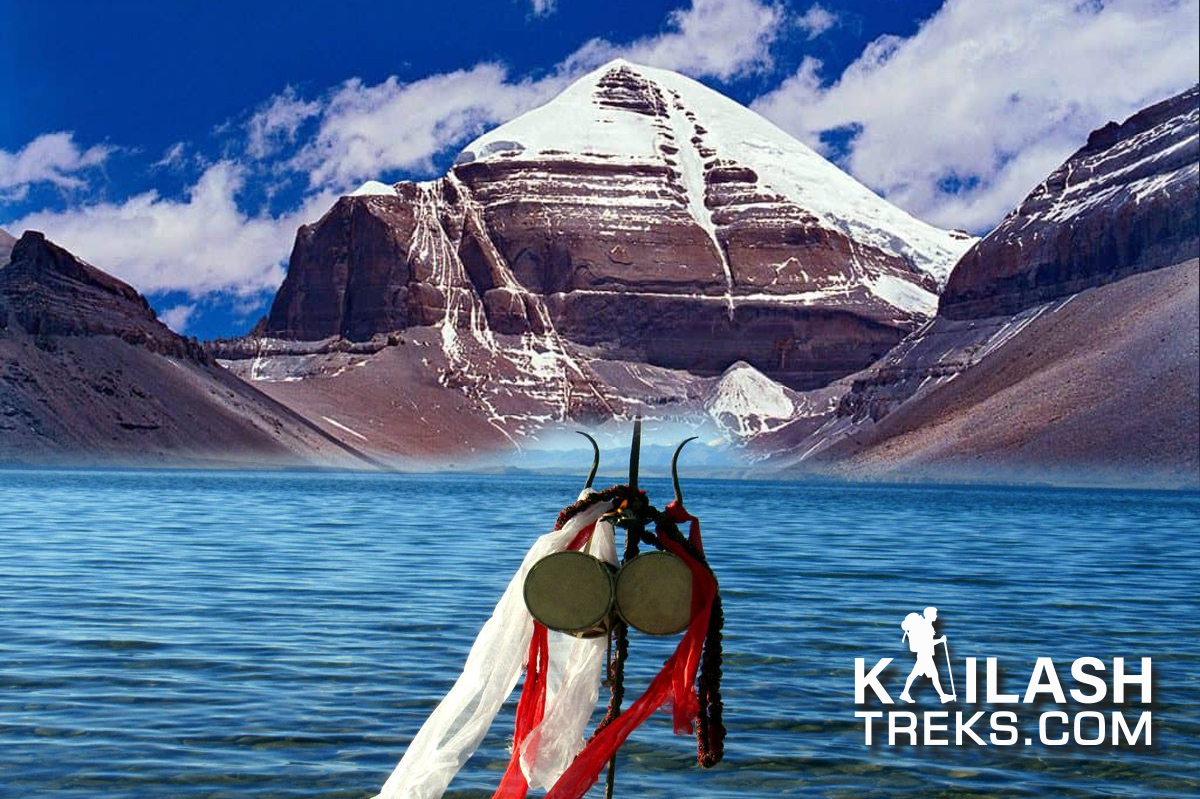
Far beyond the grasp of ordinary travel lies a sacred journey that transcends terrain, time, and thought — the pilgrimage to Mount Kailash and Lake Mansarovar. Tucked away in the remote reaches of Tibet, this spiritual odyssey is not just a physical trek but a divine calling for countless Hindu devotees, seekers, and saints.
🕉️ Mount Kailash: The Throne of Lord Shiva
Rising to a majestic height of 6,638 meters, Mount Kailash is unlike any other peak on Earth. For Hindus, it is the abode of Lord Shiva, the Mahadeva, who sits in deep meditation with Goddess Parvati by his side. Described in ancient scriptures like the Skanda Purana and Shiva Purana, Kailash is not merely a mountain — it is Shiva himself, a living deity and the axis of the world.
Hindus believe that performing a Parikrama (circumambulation) around the mountain (a 52 km trek) destroys lifetimes of sins and brings spiritual liberation (moksha).
🌊 Lake Mansarovar: The Sacred Mirror of Purity
Just a few kilometers away from Mount Kailash lies the serene and spellbinding Lake Mansarovar. Formed from the mind of Lord Brahma, according to Hindu mythology, it is considered one of the holiest lakes in the world.
The word "Manasarovar" is derived from Sanskrit:
-
Manas (mind)
-
Sarovar (lake)
It means "Lake of the Mind."
Pilgrims take a holy dip in the icy waters of Mansarovar to cleanse themselves of sins and negative karma. It is also a tradition to collect its waters in copper vessels and bring them back home as blessings.
🚶♂️ The Spiritual Journey: Parikrama and Pilgrimage
The Kailash-Mansarovar Yatra is not easy, but its spiritual reward is immense. Most pilgrims undertake the journey via Nepal or the Indian government-organized routes. After reaching the Tibetan side, the 3-day Parikrama around Mount Kailash begins:
-
Day 1: Darchen to Dirapuk (stunning views of Kailash north face)
-
Day 2: Crossing Dolma La Pass (~5,630 m), the toughest part
-
Day 3: Descend to Zuthulpuk and complete the circuit
Many devotees believe that completing the Parikrama even once earns immense merit. Some devout pilgrims even perform the Parikrama by prostrating (Dandavat Pranam) the entire way — an act of ultimate devotion.
✨ Mystical and Miraculous Beliefs
-
No human has ever summited Mount Kailash — all attempts have failed mysteriously.
-
Locals believe time flows differently here — some pilgrims report seeing visions or feeling timeless energy.
-
The four major rivers of Asia (Indus, Sutlej, Brahmaputra, Karnali) originate near Kailash, adding to its cosmic significance.
🙏 Why Every Hindu Should Undertake This Yatra (At Least Once)
The journey to Kailash and Mansarovar is not just about visiting a place — it's about reconnecting with the divine, facing your inner self, and experiencing the silence where Lord Shiva dwells.
It is said, “Unless Shiva himself calls, one cannot reach Kailash.”
So if you feel the pull — listen. The mountain awaits not your footsteps, but your surrender.
🛕 Tips for Pilgrims
-
Prepare physically and mentally — altitude is a real challenge.
-
Acclimatize properly before the Parikrama.
-
Carry essential items: warm clothes, trekking boots, spiritual books, and faith.
-
Choose a trusted travel operator if going via Nepal.
-
Keep your heart open — this is not just a destination, it’s a divine journey.
🕊️ Conclusion
Mount Kailash and Lake Mansarovar are not just landmarks on a map — they are beacons of faith, glowing in the Himalayan silence, inviting those ready to seek the eternal. For Hindu devotees, this is the ultimate pilgrimage, where each step is a prayer, each breath a mantra, and each view a glimpse of the divine.
Om Namah Shivaya.